6. THE POMANDER — THE CASE OF THE 1505 WATCH
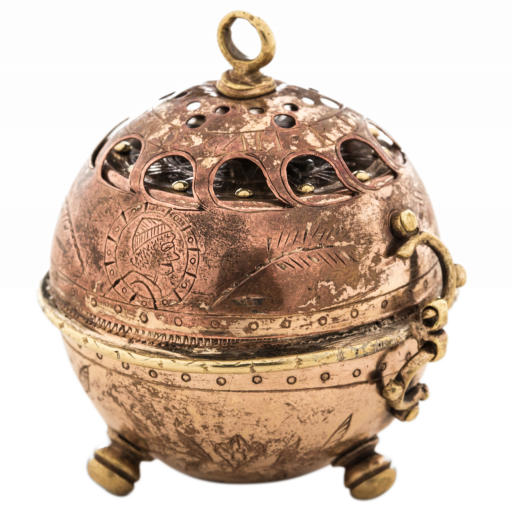
The case of the 1505 Watch takes the form of a fire-gilt pomander. The term derives from the French pomme d’ambre—‘ambergris apple’—and originally referred to a spherical aromatic preparation made from precious substances such as ambergris, musk, resins or spices. Over time, the name came to denote the finely crafted container in which these substances were held.
Pomanders are documented in Europe from the late Middle Ages onwards and, particularly between the 13th and 16th centuries, developed into precious objects of luxury, adornment and practical use, worn on the body. The aromatic substances contained within them served not only to diffuse pleasant fragrances. According to the medical and natural-philosophical beliefs of the period, they were also thought to possess protective and health-giving properties. Pomanders thus combined precious materials and fine craftsmanship with the intimacy of being worn on the body, social display and contemporary beliefs in the protective efficacy of their aromatic contents.
Against this historical background, the choice of a pomander as the case of the 1505 Watch was central to its conception. Rather than being placed in an entirely new form of case, the miniaturised movement was housed in a culturally familiar and prestigious object already worn on the body. The pomander provided the physical framework for the movement, determined the watch’s outward form and enabled it to be worn. Through its union with the movement, the pomander became a vehicle for mechanical timekeeping for the first time.
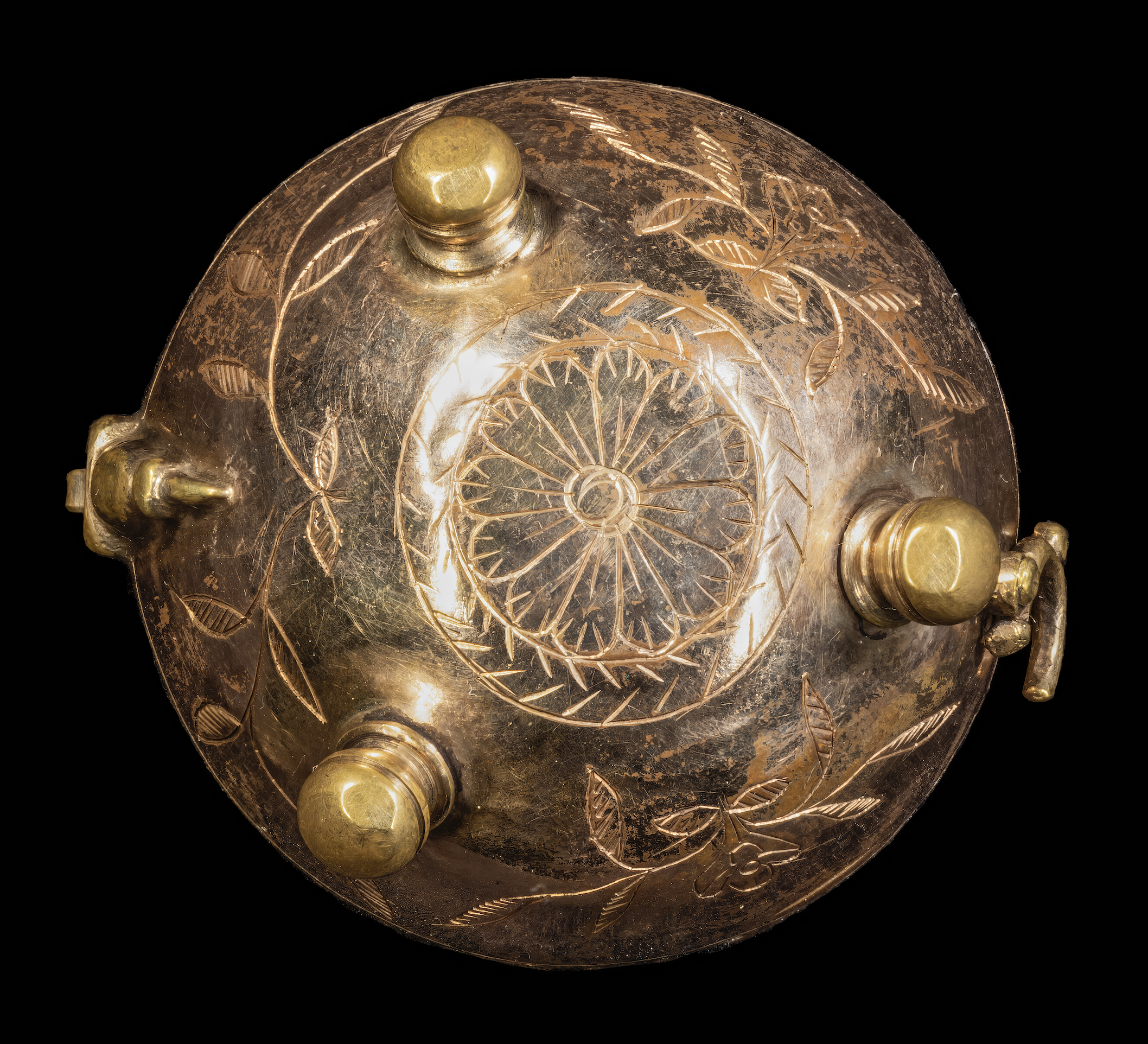
The pomander is made of copper, fire-gilt on the exterior and fire-silvered within. It measures approximately 4.15 × 4.25 centimetres, extending to 4.5 centimetres across the equatorial rim, and weighs 38.5 grams. Its upper, middle and lower shell sections are joined by a single hinge. The mechanical movement is fitted precisely within this case.
The exterior of the pomander is arranged as a clearly articulated composition. It incorporates the dial with Roman numerals I to XII; an outer ring with Arabic numerals 13 to 24; engravings; two dial-like medallions, one depicting a male portrait and the other a cityscape; ornamental bands; and the encircling Latin inscription. These elements are not merely decorative. Taken together, they endow the pomander itself with multiple layers of meaning.
The pomander is therefore far more than a protective or decorative shell. Its physical form provided the structural framework for incorporating the movement and made the watch wearable; its exterior decoration placed the mechanical innovation within the symbolic, social and cultural world of its age. Together, these two dimensions transformed an established cultural form into the means by which mechanical timekeeping became personally accessible
In this union, the 1505 Watch brings together horology, mechanical construction, the mastery of materials, goldsmithing, engraving, ornamental design and humanist reflection within a coherent whole.
The following chapters trace the development from the origin of wearable personal time to its significance for human orientation. They reveal how the dial, medallions, engravings and, above all, the inscription transform the exterior of the pomander into a vehicle for cultural and humanist reflection on time.