THE DISCOVERY
Exploring the Origins of Wearable Time
The 1505 Watch belongs to those rare historical works whose full depth begins to unfold only through the continuing process of their exploration. With every further analysis, every technological reconstruction, every examination of its internal mechanics, and every renewed observation of its external structure, an expanded understanding emerges of an object whose historical, mechanical, and cultural significance has not yet become fully visible.
The engagement with the 1505 Watch therefore does not pursue the isolated examination of individual elements, but rather the systematic exploration of an interconnected historical system.
Mechanics, construction, miniaturization, component architecture, engravings, inscriptions, surface organization, and formal structure are not understood as separate layers, but as interconnected components of an extraordinarily complex overall work.
Precisely herein lies the singularity of the 1505 Watch.
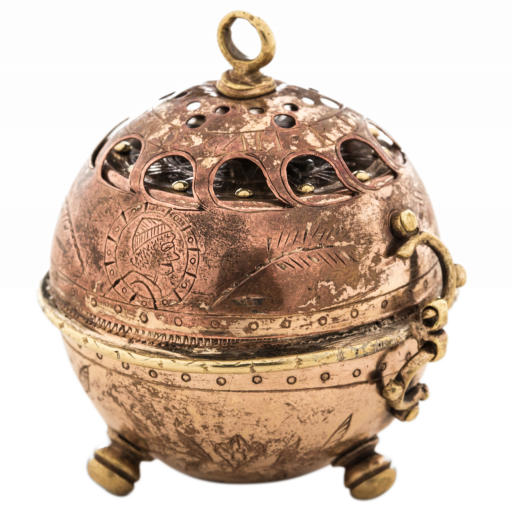
For both the internal mechanics and the external architecture of the pomander case reveal an exceptional density of constructive, formal, and meaning-bearing relationships.
The historic movement itself belongs to the earliest known wearable mechanical systems in human history. At the same time, the external structure of the 1505 Watch presents a multilayered surface architecture composed of engravings, symbols, geometric orders, and inscriptions whose interrelationship becomes comprehensible only through the object as a whole.
The exploration of the 1505 Watch therefore encompasses both the analysis of its internal mechanical functional logic and the examination of its external formal and semantic structure. Construction and surface, mechanics and meaning, technological innovation and cultural articulation do not stand beside one another as separate domains, but instead form an interconnected historical system.
The works surrounding the 1505 Watch have been carried forward for years across different levels of technological, historical, and constructive exploration. High-resolution imaging, digital reconstructions, system-technical analyses, and the continuing examination of its internal and external architecture are enabling increasingly deeper insights into the constructive operating principles of this extraordinary work.
The objective is not merely to answer isolated historical questions. Rather, step by step, a more comprehensive understanding is emerging of those mechanical, formal, and meaning-bearing relationships that establish the 1505 Watch as a singular point of origin of wearable time.
With the increasing depth of this exploration, it is simultaneously becoming visible that the 1505 Watch extends far beyond its historical and mechanical significance alone. For the 1505 Watch is increasingly becoming readable today also as a bearer of meaning — as a historical object whose inscription, surface architecture, and mechanical structure together open a space of human reflection upon time, perception, and conscious orientation.
Precisely this dimension of meaning has never before been publicly presented in its full depth.
Only through the continuing convergence of mechanical analyses, technological reconstructions, historical contexts, and the examination of its external architecture is the hidden cultural, philosophical, and meaning-bearing dimension of the 1505 Watch gradually beginning to become visible.
The exploration of the 1505 Watch is therefore not complete.
With every new analysis, the 1505 Watch becomes increasingly readable — not merely as a historical object, but as an interconnected system of mechanics, construction, surface, meaning, and humanity’s relationship with time. Precisely from this arises the responsibility to continue the exploration of the 1505 Watch exclusively in collaboration with internationally leading personalities, institutions, and companies within their respective fields.
For the historical, cultural, and technological significance of this work demands the highest degree of precision, the greatest possible responsibility, and a long-term international perspective. Precisely herein lies the extraordinary contemporary significance of the 1505 Watch.
For the questions of time, orientation, conscious perception, and the relationship of the human being to their own moment transcend cultural, societal, and geographical boundaries. In an age of increasing technological acceleration, the conscious relationship of the human being to their own time acquires a new universal significance.
The 1505 Watch thereby becomes readable not only as the historical origin of wearable timekeeping, but increasingly also as an object of human reflection whose significance extends far beyond the period of its historical creation.
With every further exploration of its mechanical, constructive, and meaning-bearing relationships, the 1505 Watch increasingly opens itself as a space of human orientation — as a historical work that confronts the human being not only with the measurement of time, but with the conscious relationship to their own life within time.